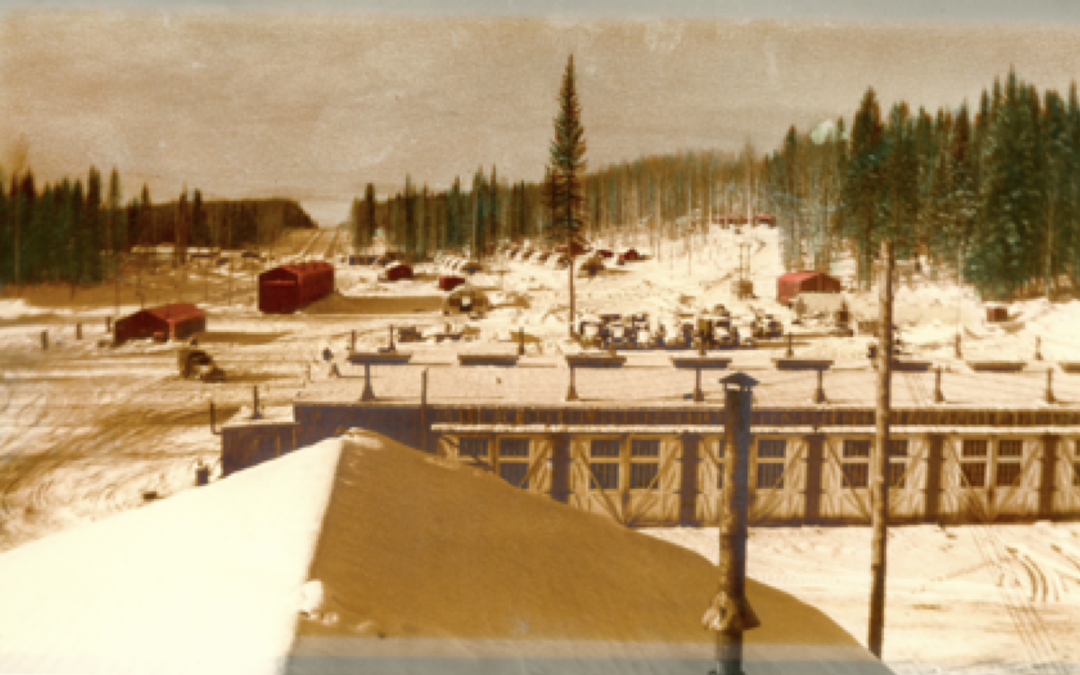
Mile 300 Fort Nelson in 1951: Snob Hill on the hill at the right. Skunk Hollow on left in the trees. Picture looking west with the shop in the front.
Warren Moore recalls his first Christmas on the Alaska Highway:
It was December 21st in 1951 and I was about ten years old when we travelled as a family north from Grande Prairie, to Fort Nelson at Mile 300 on the Alaska Highway. My dad had just been hired by RCEME Royal Canadian Electrical Mechanical Engineers for a job as a mechanic, up in Fort Nelson, British Columbia.
We left Grande Prairie, Alberta in our 1949 Dodge car on our way to Fort Nelson. The first night on the road, we stayed with friends in Dawson Creek, the Mile Zero city of the Alaska Highway. When we arose the next morning, it was cold; the kind of bitter winter cold that only Northerners know about. The family got settled in the car once again and at about five miles north of Dawson we were stopped where there was a Wig Wag signal and two soldiers with guns on their shoulders. These Wig Wag signals were used to stop traffic for a variety of reasons, often at railroad crossing but, in this case, it was for driver safety and communication about road conditions.
Dad got out and went into the building that was there. After fifteen minutes, he came out with a locked mailbag, maybe leather or canvas. He put it in the trunk and started on our way north once again. In those days, civilians who were travelling, helped to transport the mail north on the Alaska Highway. If you had the locked bag, you would take it into the Wig Wag building, officials would unlock it, take out their mail, put in the mail that was going further north along the highway, lock it and give it back to you to transport it as far north as you were going. The fellows in the Wig Wag had also given my Dad something else – a bottle with a cork in it and some paper towels. Often the car windows would frost up so badly, a person couldn’t see a thing when they were travelling in cold weather. This bottle contained some alcohol and us kids used it to clean our windows so that we could see the sites out the side windows!
In those days, the government stopped traffic at Dawson Creek, Fort St. John and Wonowon and in fifty-mile increments thereafter, using these Wig Wag signals. These stoppages were controls, in case of emergency in cold weather and important for travellers, especially those with families. When travelling north of Fort St. John, if a person or group didn’t show up at the next barricade, they came to your rescue. I believe this winter program lasted until 1952. We got to Mile 147 and we stayed at Anderson’s Lodge. I remember we stayed upstairs in the old building and it smelled so badly of diesel soot, it was hard on the eyes. All along the highway, people heated their homes and lodges with diesel burning heat. Sometimes it would leak from the stove pipes and it always had a strong burnt smell. The next morning, we got up early and Mrs. Anderson had made us breakfast and packed a lunch for the road. Good old Northern hospitality!
We went onto Fort Nelson, arriving safely. We checked in at the Fort Nelson Hotel, which was another old army building. Women weren’t allowed in any of the camps because there were only quarters for single men. That’s why we were staying in hotels and motels. We got up the next morning, and went down to the café which was in front of the hotel. In the café, there were a bunch of single men. There was Nick Czban, Paul Rivest, Bert and Harold Lillico, George Miller, Hump McGuire, and three more fellows that were Dad’s friends. Lloyd Robins was the driver of the moving truck that had left Grande Prairie and he had gotten as far as Trutch, Mile 200, and had broken down. My mother was just fit to be tied as it was getting so late and close to Christmas.
A mechanic in Trutch worked on the moving truck until it was drivable so that it wouldn’t be held up on the Christmas holiday. We weren’t aware that our truck was back on the road and travelling toward to Fort Nelson! Nick stopped by and said he’d take us to the Mess Hall at about 1:00pm as there was a Christmas Party for the children. We got there and the hall was alive with kids and Santa brought gifts and candy. We had a really nice time and at about 4:30, Nick appeared and we got ready to leave. The old baker at the Mess Hall came out and he had three loaves of bread, which he put in my arms to take home to my family. He told me to tell Dad to come over around noon the next day, and he would be given all the fixings for Christmas dinner, the turkey and everything, to take home for our family Christmas feast. Mom wouldn’t have to worry about making Christmas dinner in a hotel. The goodwill and hospitality of these Northern folks was so appreciated!
We got in the pickup truck with Nick and drove across the highway to a place called Skunk Hollow, which is now known as the West Fort Nelson Campground. Nick stopped the truck in front of one of the buildings and there were about nine families who lived there, as well as a three unit complex where our family would live for $10 per month. There was also a dilapidated, old building that was a theatre. The seats were made out of wood and they had old mattresses to sit on.
When we opened the door of the middle unit in the rental complex, we could hear people singing Christmas carols and I could hear Mom playing the piano. We went in we saw the house was all decorated, the beds were made and they were having a party! The guys had moved everything in, once the truck had arrived and even set up my Mom’s piano! We couldn’t believe it! We were ready for Christmas and you can imagine how happy my mother was! The festivities went on for a while, but the kids had to go to bed. The next day, Dad went over to Mess Hall and sure enough he brought home all the food for Christmas dinner and even the turkey, provided by the generous cook at the Mess Hall.
We had Christmas dinner in our own house, which meant a lot to us as a family. That’s the memory I have of my first Christmas on the Alaska Highway!
Recent Comments